
Diluted bitumen is the major crude oil export product from Canada’s Oil Sands, and is shipped across the continent by rail and pipeline. The Trans Mountain Pipeline (TMP) carries diluted bitumen through sensitive regions of the Fraser River Watershed (FRW), Canada’s largest salmon-bearing system. Spills from the TMP have occurred at an average rate of 1.3 per year since 1961, raising significant concerns about accidental contamination of the FRW and the impact on vulnerable Pacific salmon populations. Pacific salmon have a complex life history that bridges freshwater and marine ecosystems, so life stage specific data is needed to aid spill response planning and impact assessments. Since 2014, our collaborative team has been building a knowledge base on the consequences of environmentally-relevant diluted bitumen exposures to salmon, including impacts on performance metrics, developmental effects, persistence/latency of toxic responses, life stage specific sensitivities, confounding effects of abiotic factors, and development of biomonitoring tools for impact assessment.
Projects
1. RESPONSES AT EARLY LIFE STAGES
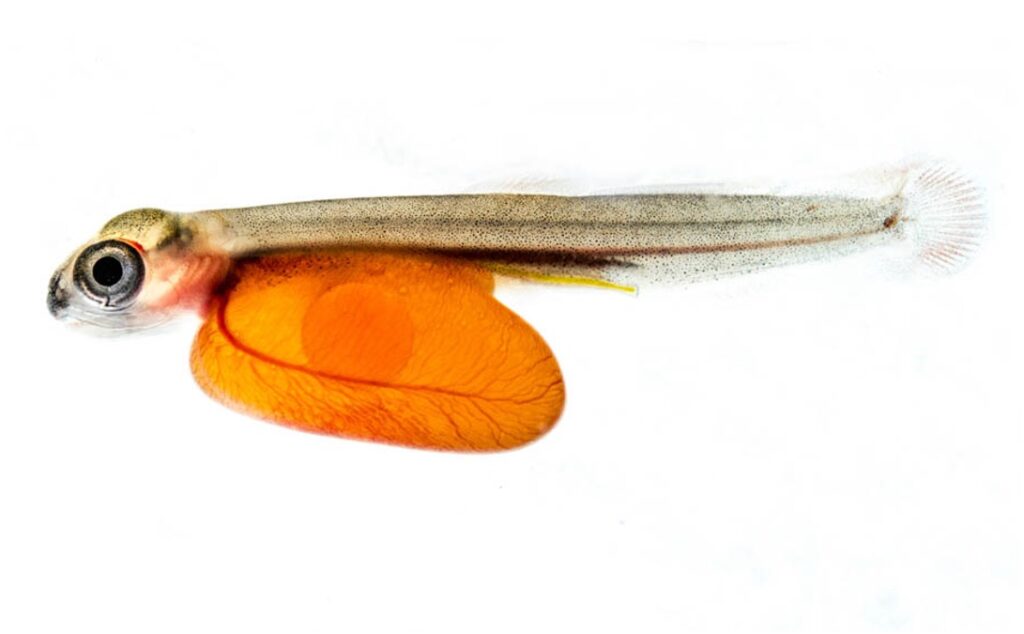
Pacific salmon are most vulnerable to diluted bitumen exposure during early development prior to emerging from redds. We assess the biological outcomes of diluted bitumen exposure during these early life stages using low, environmentally-relevant concentrations, with an emphasis on cardiorespiratory impairments in coho and sockeye salmon. Our most recent work aims to identify critical windows of sensitivity and to address toxicity responses in the context of global heating.
image: A coho salmon alevin, showing prominent yolk sac. Sourced online.
2. ECOLOGICAL RELEVANCE OF EXPOSURE
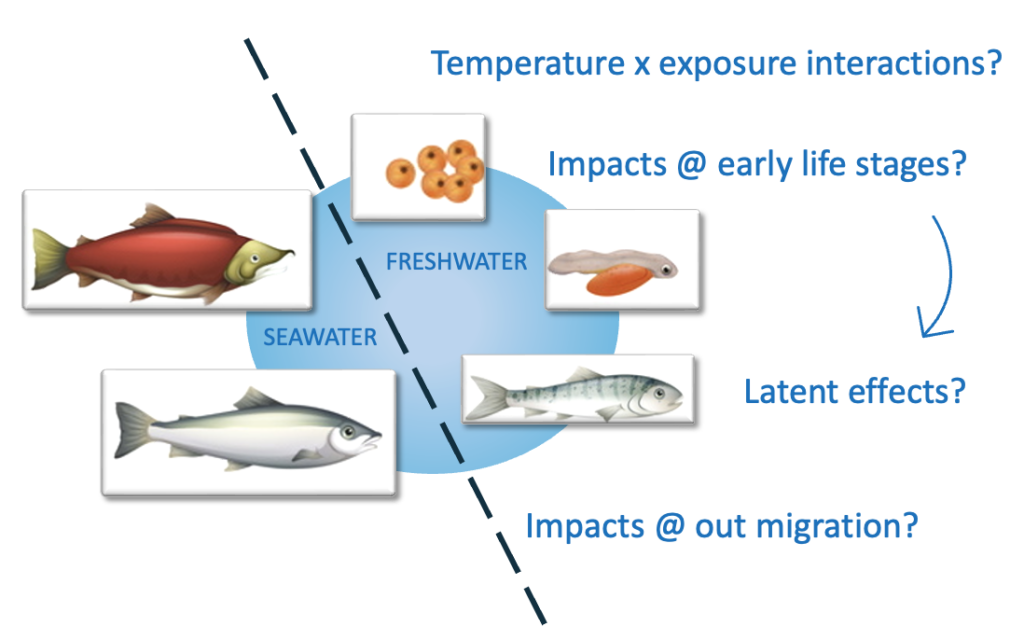
Pacific salmon life history includes residency in gravel beds (eggs, alevins), streams and lakes (fry, parr), and the open ocean (subadult, adult) before they return to freshwater natal streams for a single lifetime opportunity to reproduce. Transitions between these stages requires chemical imprinting, osmoregulatory remodeling, and extended migrations. We assess whether diluted bitumen exposure affects the physiological underpinnings of these life history transitions to better understand how a pipeline spill may impact vulnerable salmon populations. We are currently assessing how diluted bitumen exposure affects migration capacity, contaminant transfer to gametes, and progeny fitness in sockeye and coho salmon.
image: Schematic of sockeye salmon life cycle showing guiding framework of our research on early life stages. Source: S. Alderman
3. PREDICTING AND MONITORING THE IMPACTS OF A PIPELINE SPILL
A combination of salmon life stages may be present in the receiving environment at the time of a spill, depending on when and where a spill occurs. Predicting and assessing spill impacts, as well as deciding on remediation priorities requires empirical data on life stage specific responses of key fitness metrics. Our research is establishing the knowledge base needed for evidence-based decision making. Specifically, we are: (1) validating non-lethal biomonitoring approaches, including tissue biomarkers and eDNA; and (2) using our data to build a computational tool that can project population-level impacts of a spill with user-defined variables (in collaboration with Poisson Consulting).
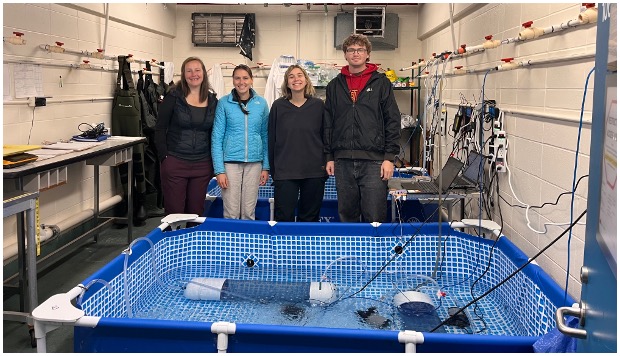
image: Members of our team in Fall 2025 conducting metabolic rate assessments on adult sockeye salmon that were exposed to diluted bitumen. Left to right: J. Matsumoto, A. Belrose, F. Belaire, N. Walker
Funding

Collaborators
Dr. Todd Gillis, University of Guelph (Projects 1, 2, 3)
Dr. Chris Kennedy, Simon Fraser University (Projects 1, 2, 3)
Dr. Anthony P. Farrell, University of British Columbia (Projects 1, 2)
Dr. Erika Eliason, Fisheries and Oceans Canada (Project 3)
Dr. David Patterson, Fisheries and Oceans Canada (Project 3)
Dr. Robert Hanner, University of Guelph (Project 3)