Fishes have an unrivalled capacity for lifelong neurogenesis, including a high rate of neurogenesis in all major divisions of the adult brain. While this phenomenon is well-recognized, there remain considerable gaps in our understanding of how neurogenesis is regulated and the implications of this neuroplasticity on physiology and behaviour. We are especially interested in the role of steroid hormones, including cortisol, in regulating brain cell proliferation.
Projects
1. MOLECULAR PATHWAYS
Cortisol exerts myriad effects on the brain, including context-specific regulation of neurogenesis, but the mechanisms are poorly understood. The zebrafish brain expresses an abundance of 11beta-hydroxysteroid dehydrogenase type 2 (hsd11b2), an enzyme that irreversibly inactivates cortisol. We are studying the contribution of this enzyme to stress-induced changes to neurogenesis.
image: Localization of hsd11b2 mRNA in three regions of the zebrafish brain. From: Alderman & Vijayan 2012

2. DEVELOPMENTAL PLASTICITY
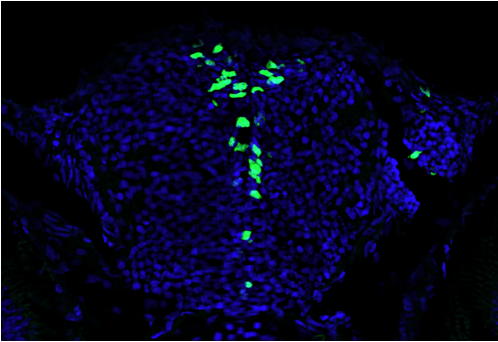
Stressors experienced during critical developmental windows shape organismal phenotype. We are studying neurogenesis as one mechanism of developmental plasticity, including proximal drivers (e.g., environmental complexity), endogenous regulators (e.g., cortisol), and organismal outcomes (e.g., behaviour).
image: Transverse section of a 5dpf zebrafish brain showing labeled mitotic cells used to quantify and qualify changes in neurogenesis [green: EdU, blue: DAPI]. From: Bourdeau & Alderman 2025
3. FUNCTIONAL CONSEQUENCES OF IMPAIRED NEUROGENESIS
Chronic stress impairs forebrain neurogenesis in zebrafish, but the biological significance of this response is unknown. We are testing several competing hypotheses to understand whether and how impaired neurogenesis is dictated by physiological and behavioural trade-offs.
image: Representative heatmap tracings of a zebrafish in a novel tank dive test at two timepoints following 4 days of social subordination. Image credit: A. Wiseman


4. EVOLUTIONARY PERSPECTIVES
Adult neurogenesis has been described in <0.1% of extant fishes, primarily teleosts, and it remains unclear whether the brains of agnathans (lamprey, hagfish) retain neural stem/progenitor cells as adults. Using a combination of histological, pharmacological, and experimental approaches, we are investigating the evolutionary origins of adult neurogenesis and its regulation by glucocorticoids.
image: Neuronal markers in the brain of a Pacific hagfish [red: NeuN, green: HuC/D, blue: DAPI]. Image credit: S. Alderman
Funding